Dress Up reports · ^du_report(7) · 2026-10-18 · about Messed Up Dress Up, a game made with M and N · after ^du_report(6)
Stories and stress
Matthew's hypothesis: M extends the game for social stories, about the whole system; N extends it for stress tests, of the whole system. Does the record of their requests bear that out? Read against every ticket on the dashboard that came from either of them, open and closed, up to the game at 0.0.282.
- N's half holds. Of N's 13 requests, 8 (62%) push the game to a limit: 3 by load (as many cauldrons as he could put in a place, until the black laptop froze; then again past the warnings; a room made of bubbles, 521 animations at first) and 5 by its rules at their edges (falling into the pits, boulders, being hit by one, and asking to pull the lever from where the boulder lands).
- M's half holds, with a second half of its own. 9 of M's 22 requests (41%) make room for a story or for something of one's own: her castle, its colours and her letter, a dining room with 4 to 18 places at table, a grass hut and its rooms and a village of them, ears, lichen, and no skeletons. But 6 more (27%) are about the tools themselves (World design's arrows and an "all passageways" button, a dark theme, the version notes and a pop-up for new ones): M is the game's first critic of how it is made.
- Both reach across the whole system: M's requests named 14 parts of it, N's 11 (Figure 3). M's spread wider; N's went deeper into a few: performance, the castle's trap room, animation.
- Each also found faults the other did not: M's iPad lost the levers' touches, and her lever and trap door would not join; N's old laptop could not walk in our imagination, which became the speed gate's slow tier (
^du_report(2)). - The record cannot say why. It holds what Matthew relayed, in his words; the children's own reasons are not in it. Step 1 of What next asks them.
What they asked for
Figure 1. Each request sorted into one kind, by reading its ticket (the table below gives each). The castles, ^ticket(67), are counted for both: each of them has one.
Figure 2. Their requests by the day the ticket was made, 14 to 18 October 2026. M's peaked on the 15th (the castle's rooms) and the 18th (the grass hut, music, the version pop-up); N's were steadier, 0 to 4 a day, the cauldrons on the 17th and the boulders on the 18th.
A room from each
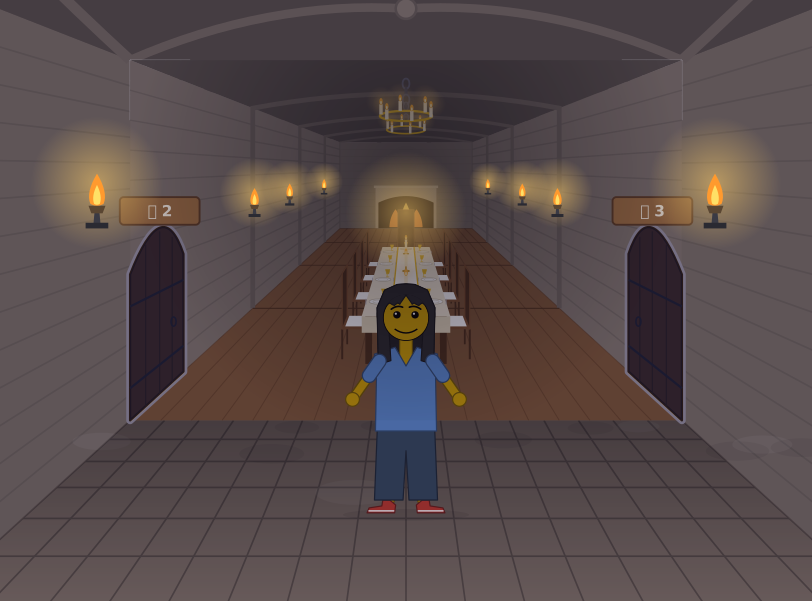
^ticket(110)): a long table, places for 4 to 18, candles and chandeliers.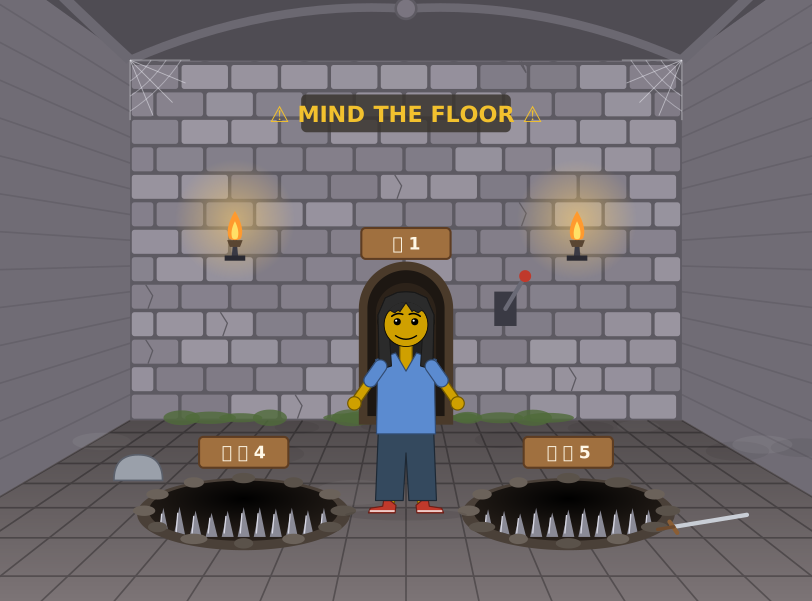
^ticket(162)) and boulders (^ticket(323)) are.Messed Up Dress Up 0.0.203, from the picture archive's run of 2026-10-18 09:49 MDT: before the grass hut, the bubble room and the boulder levers, which came later that day.
M: stories, and the tools to tell them
M's requests make places to live and gather in, and make what is hers recognisable: the castle in her colours with her letter readable on its banners (^ticket(72)); a dining room for a whole household (^ticket(110)); a grass hut with a living room, a bedroom and a potion room, made round, then a cluster of huts round a center (^ticket(278), ^ticket(281), ^ticket(282)); ears for the friend (^ticket(125)); lichen to dress rocks and walls (^ticket(319)). And she asked for the scary things to go (^ticket(73)), which became a rule for the whole game: nothing scary unless asked for.
The other strand is the making. She found that World design let a way out point off the map, and asked for those arrows to be disabled (^ticket(189)); she asked for one button to join every pair of neighbouring squares (^ticket(195)); a dark theme (^ticket(194)); and, to follow the work as it happened, the version notes in the game and a pop-up when a new version is out (^ticket(200), ^ticket(302)). These are a designer's requests about her own tools.
N: the limits, by load and by rule
N tests what happens when there is too much, or when the rules are taken literally. On the black laptop he put cauldrons into a place, with their fumes, until the computer ground to a halt (^ticket(201)); given red boxes that marked the costliest things, he ignored them and kept going until it froze again (^ticket(203)), so the game now refuses more until the red box is dealt with. The bubble room he asked for began at 521 animations (^ticket(290)).
The other strand is consequence. He asked to fall into the castle's pits and land in the dungeon below (^ticket(162)), for boulders to fall onto the pits (^ticket(323)), for the friend to burst into bubbles when one lands on them (^ticket(349)), and, once a lever had to be walked to, for a way to pull it from where the boulder falls (^ticket(364)). This is play at the edge of the rules, much as a fuzz test feeds a program what no one expected [3].
Where the record disagrees
- M is not only a story-teller. A quarter of her requests (6 of 22) improve the tools; on this record she is as much the game's first UX critic as its storyteller.
- Not all of N's are stress. His first was to explore: inside the tents, the cave behind the waterfall (
^ticket(49)); and a visibility panel, to make the friend invisible or a ghost (^ticket(51)), is play with the character rather than a test of the system. - Devices shaped both. Two of M's requests come from her iPad (no USB port for the controller,
^ticket(150); touches lost on the levers,^ticket(350)), and one of N's from his old laptop (^ticket(154)): what they own decided part of what they found. - Counting is coarse. One kind per request, sorted by Claude from Matthew's words; a second reader might move a few. The shares above are not sensitive to one or two moves: N's stays above half, M's story share above a third.
The record
| ticket | from | made | what was asked | kind | what it cost or exposed |
|---|---|---|---|---|---|
^ticket(67) | M N | Oct 14 | three castles, each child's own (N's, M's, and one for D), with rooms | story | the castle designer and its seven room kinds |
^ticket(72) | M | Oct 14 | castle colours: banners in two colours, the owner's letter always readable (M's gold letter on a gold banner did not show) | story | a contrast rule for the letter |
^ticket(73) | M | Oct 14 | no skeletons unless asked for: the dungeons were too scary for M | story | a slider per dungeon, starting at 0; a design rule (nothing scary unless asked for) |
^ticket(99) | M | Oct 15 | a drawing fault M caught (the lantern), then a pass over all such faults | fix | a sweep of lines past their shapes |
^ticket(108) | M | Oct 15 | a hallway whose stairs lead nowhere ends in a wall | build | a wall drawn where the stairs were |
^ticket(110) | M | Oct 15 | a dining room: a long table, 4 to 18 places at it, torches, candles, chandeliers | story | a new room kind, drawn in perspective |
^ticket(113) | M | Oct 15 | eight ways out of the hallway and the dining room | build | side doors to 3 a side, far and near walls |
^ticket(116) | M | Oct 15 | doors closer, signs bigger, the screen used to the full | tool | the viewport, the save submenu |
^ticket(125) | M | Oct 15 | ears, in every view: three shapes and a size | story | ears facing us and in profile, under hair and hoods |
^ticket(150) | M | Oct 16 | an on-screen controller: the iPad has no USB port for the game controller | device | a pad drawn on the screen, as a real pad to the game |
^ticket(189) | M | Oct 17 | in World design, ways off the map can't be turned on; a way that would fix a warning is starred | tool | the designer's arrows |
^ticket(194) | M | Oct 17 | a light / dark switch | tool | a dark theme over the whole game |
^ticket(195) | M | Oct 17 | an "all passageways" button in World design | tool | joining every pair of neighbouring squares that both have the way |
^ticket(200) | M | Oct 17 | what's new, in the game: every version's notes, so M can read the recent features as we work | tool | VERSIONS.md in ⚙️ Advanced |
^ticket(278) | M | Oct 18 | a grass hut: outside, and a living room, a bedroom and a potion room inside | story | four new places (0.0.203) |
^ticket(281) | M | Oct 18 | the grass hut round, inside and out | story | round rooms: a wall curving round a flat floor |
^ticket(282) | M | Oct 18 | a cluster of grass huts, one to six rooms, with a hut center | story | huts in pairs, triads and rings |
^ticket(301) | M | Oct 18 | more couch-cushion raves, and more turtle steppers dubs, upbeat | music | nine new tracks |
^ticket(302) | M | Oct 18 | a pop-up when a new version is out | tool | a version check, off unless switched on |
^ticket(303) | M | Oct 18 | a lever wired to a trap door does not open it | fix | a wiring bug: levers and trap doors now join in either order |
^ticket(319) | M | Oct 18 | lichen, to decorate rocks, castle walls and logs | story | lichen after moss, placeable |
^ticket(350) | M | Oct 18 | the trap room's levers do nothing to a touch on M's iPad | device | a touch event dropped between pointerdown and touchstart |
^ticket(49) | N | Oct 14 | new places behind the camp, the falls and the clearing: inside every tent, the cave behind the waterfall | explore | tents and a cave, each a place with its own way in and out |
^ticket(50) | N | Oct 14 | where feet can stand in each place (rivers, the pool, the campfire) | edge | the first ground shapes: the start of the collision system |
^ticket(51) | N | Oct 14 | a visibility panel: each body part see-through, invisible, or a ghost | character | per-part see-through layers |
^ticket(154) | N | Oct 16 | our imagination too slow to walk in on the black laptop (N's old laptop) | device | the speed gate's slow tier; ^du_report(2) |
^ticket(162) | N | Oct 16 | falling into the castle's pits, landing in the dungeon below | edge | a fall and a landing, pits as holes |
^ticket(201) | N | Oct 17 | N put as many cauldrons as he could in a place, and the black laptop ground to a halt | stress | a frame-rate watch per thing, red boxes on the costliest |
^ticket(203) | N | Oct 17 | N ignored the red boxes and kept adding cauldrons until it froze again | stress | a latch: nothing more added while a red box stands |
^ticket(271) | N | Oct 17 | a trap room's pit shapes belong to that room (a bug in N's room 3) | fix | pit shapes per room |
^ticket(290) | N | Oct 18 | bubbles: a place group, and a room made of bubble foam | stress | 521 animations at first, about 140 after |
^ticket(323) | N | Oct 18 | boulder levers: boulders fall from the ceiling onto the pits | edge | boulders, then their speeds (^ticket(328)) and fallen rocks to move (^ticket(338)) |
^ticket(349) | N | Oct 18 | hit by a falling boulder, the friend bursts into rainbow bubbles and comes back | edge | the burst and the return |
^ticket(364) | N | Oct 18 | pull the levers without walking to them, to stand where the boulder falls | edge | an Advanced toggle restoring the old pull |
Left out, though the search found them: ^ticket(95) (names the rule that the children are M and N in public writing), ^ticket(104) (mentions them (a night's work while they gave no suggestions)), ^ticket(106) (the same), ^ticket(119) (a page about the game and them), ^ticket(157) (^du_report(N), the syntax), ^ticket(168) (the same), ^ticket(175) (about their devices, after the fact), ^ticket(184) (the release cadence, for their creative loop), ^ticket(212) (N the compass point), ^ticket(214) (the same), ^ticket(224) (the same), ^ticket(245) (the same), ^ticket(246) (the same), ^ticket(249) (the same), ^ticket(312) (the same), ^ticket(339) (this report).
What their requests reached
| part of the game | M | N |
|---|---|---|
| castles | 6 | 4 |
| places | 4 | 3 |
| performance | 4 | |
| levers | 2 | 2 |
| world designer | 2 | 2 |
| drawing | 3 | 1 |
| UI | 4 | |
| animation | 3 | |
| character | 1 | 2 |
| objects | 2 | |
| controller | 1 | 1 |
| touch | 2 | |
| releases | 2 | |
| music | 1 | |
| collisions | 1 | |
| world | 1 | |
| content | 1 | |
| settings | 1 |
Figure 3. Each request counted once for each part of the game it named.
Related work
Children have been design partners in making technology for them since Druin's cooperative inquiry [1], and informants at chosen stages of a design before that [2]. Here they are both at once, with a turnaround of hours: they ask, and the version with their request is live the same afternoon (^du_report(6)). N's way with the game resembles fuzz testing [3]: inputs no designer would choose, in volume, until something breaks.
What next
- 1. Ask them: show M and N this report's two readings (stories and tools; load and consequences) and ask each, in their words, what they were after; add their answers as a dated note, which the record alone cannot give.
- 2. Say who asked, when a ticket is made: a "from" field on the dashboard's tickets (M, N, Matthew), so the next count needs no search and has no compass-point false matches.
- 3. N's stresses as checks: his cauldron flood (
^ticket(201),^ticket(203)), the bubble room (^ticket(290)) and standing under a boulder (^ticket(349)) as speed-gate cases, so what N found stays found. - 4. M's stories as a game: the dining room, the hut village and the castles as settings for
^du_report(6)'s missing pieces: people who talk, things to carry, a goal. - 5. M's tools next: her World design requests (
^ticket(189),^ticket(195)) point at the full-screen designers (^ticket(285),^ticket(365)): ask her to try them first. - 6. Count again later: the same reading at version 0.1, to see whether the two strands hold as the game grows.
How this was put together
Written on 2026-10-18 by Claude, for Matthew, from the dashboard's tickets (open and closed; every Dress Up ticket whose text names M or N, read one by one, with the false matches left out as listed), the game's VERSIONS.md, and the sources below. Nothing measured: the counts are of tickets, each sorted into one kind by reading it. The pictures are the picture archive's. The data is in data/report.json and in this page; the page is built by drivers/build.py.
- Allison Druin. Cooperative inquiry: developing new technologies for children with children. CHI 1999.
- Mike Scaife, Yvonne Rogers, Frances Aldrich, Matt Davies. Designing for or designing with? Informant design for interactive learning environments. CHI 1997.
- Barton P. Miller, Lars Fredriksen, Bryan So. An empirical study of the reliability of UNIX utilities. Communications of the ACM 33(12), 1990.