Dress Up in Hazel: the hard part of the drawing is what runs every frame, the music can be computed, and the menus need a layout Hazel lacks
Matthew asked three questions about porting Messed Up Dress Up to Hazel (ticket 402): which parts of the drawing would be hardest for Hazel, whether Hazel can do music, and how to offer the game's menus in Hazel while keeping to Always Be Knolling. He also asked for the game's advanced features, staged as challenges. It builds on ^du_report(8) (the port, piece by piece), ^du_report(5) (the menu rules) and ^report(15) (the game and its livelits, measured side by side). The game at 0.0.334; Hazel on its livelits × modular editors branch (hazelgrove/hazel#2635) at 90ed4505bf. That commit already carries all 14 of the performance PRs on Hazel's dashboard, as merged or in #2635's own form, so every Hazel number here is after them; ^report(25) measures what they do.
Short answers.
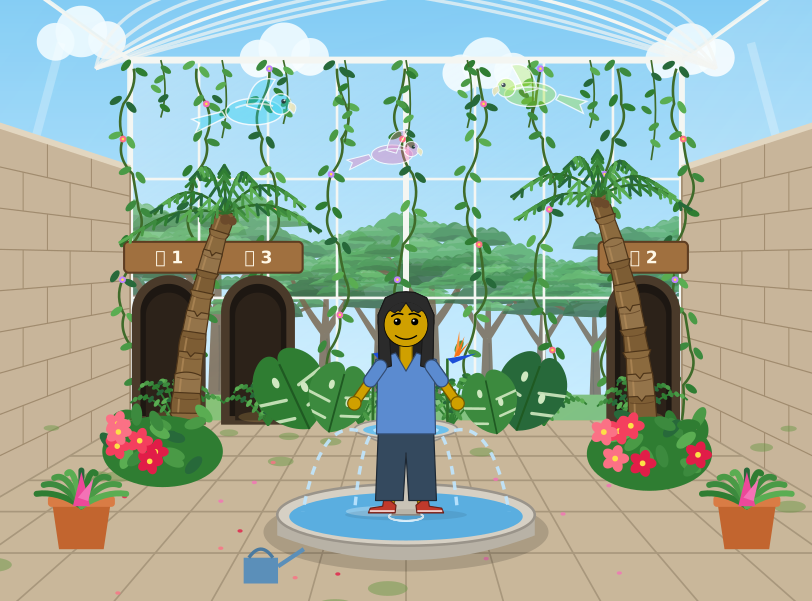
The drawing's hard part is not its SVG but what runs around it. A Hazel view can draw every element the game uses (41 SVG element kinds, gradients, clips, masks, filters and animations included). What Hazel lacks is what the game does at run time: motion every frame (a livelit has no clock, and a change costs 0.13 to 1.09 s against a frame's 16.7 ms), measuring the drawn picture (about 100 calls place things on it), its sizes (the greenhouse has 1,906 elements; the largest Hazel picture so far, 570 shapes), and byte-exact numbers: Hazel's to_fixed and the game's f1 disagree on 5 of 7 values tried.
Music: Hazel can compute it today; playing it takes a JS player or a new builtin. 63% of the game's music code is pure (the tunes, chords, arrangements and the score of note events). A Hazel program computed a 1,216-event score, the size of the forest tune's, in about 0.2 s with Hazel's command-line tool, and in about 0.14 s through Hazel's JS library in node, the same before and after the performance PRs. A livelit cannot make a sound; Hazel's MVU apps can, a sine beep (Cmd.PlayTone) with timers, which corrects ^du_report(8)'s "no sound binding".
The menus: Hazel meets about two of the nine knolling rules, and the gap is a layout, then speed. Livelits show up inline, stacked in the UX outline, or in a sidebar column; none is a grid of named boxes. The plan: the settings as a tree of modules, a "knolled" UX layout that draws modules as tabs and their members as boxes, and big livelits for the bespoke designers. Even laid out right, each change costs 0.13 to 1.2 s; the rule "keep it fast" waits on Hazel's speed.
The advanced features fall into six stages, from pictures Hazel can draw today, through small builtins, a clock for livelits, interaction inside the picture and the designers, to the whole game at 60 fps, which waits until a change costs about 16 ms.
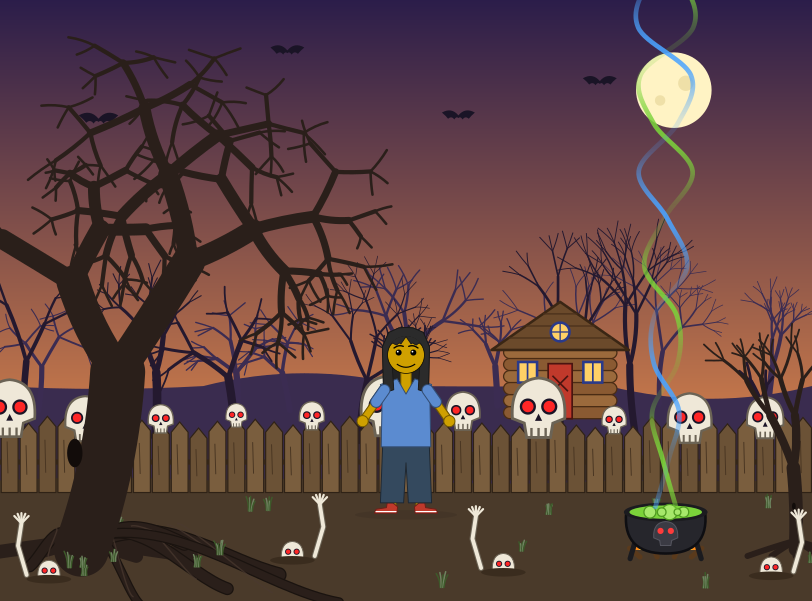
The castle's greenhouse with the friend, as the game drew it (0.0.304, from the picture archive): 1,906 elements, the most of any place.The witch's woods: 1,565 elements, 1,307 of them shapes, with their animations running.
1. Which parts of the drawing are hardest for Hazel
What the game's drawing uses (counted in js/, 0.0.334) and what it rests on at run time:
Measuring the drawn picture (getBBox, getScreenCTM, getBoundingClientRect, getPointAtLength)
about 104 calls: collision boxes, where tree-room pictures hang, ladders, foam layers, a lifted thing's centre
Every frame (requestAnimationFrame 71 lines, performance.now 56)
walking, climbing, treading water, bubbles and balls, the leak, blowing
The music's clock (the LFOs)
poses' phases, and 43 places that time scenery to the music
The DOM after drawing
the depth sort, the friend put in front of what is behind their feet, reusing unchanged pieces, still pictures on slow computers
Seeded randomness
a sine hash, Math.sin(seed·71.3 + i·13.7)·43758.5453, in 467 calls
The five hardest, ranked
Feature
Why it is hard for Hazel
The most plausible route
1
Motion every frame
Livelits have no clock, and a change costs 0.13 to 1.09 s, against 16.7 ms a frame.
Hazel computes the poses at sampled phases and writes the animation as SMIL or CSS; JS keeps the frame loop and the simulations.
2
Measuring the drawn picture
There is no way to measure layout from Hazel; about 104 calls rely on it.
A bounds library in Hazel (boxes from the geometry, with transforms and curves), or a measuring command for views.
3
Size
The imagination is 2.45 MB; the greenhouse 1,906 elements; Hazel's largest picture so far is 570 shapes.
Static scenery as one picture (an <img> from a Hazel string), only the friend as structured elements; memos keyed by explicit inputs.
4
Work done on the DOM
The depth sort, the friend's place, piece reuse and still pictures happen after drawing.
The sort and the friend's place in Hazel (they are pure over name, depth and SVG); stills and bitmaps stay in JS.
5
Byte-exact numbers
f1 is used 7,269 times and differs from to_fixed (below); the sine hash multiplies any 1-ulp difference by 43,758.
An f1-like number-to-text builtin, and a check that sin agrees bit for bit.
Tried in Hazel: the numbers in a picture
x
Hazel: to_fixed(x, 1)
The game: f1(x)
12.0
12.0
12
0.25
0.3
0.3
-0.25
-0.3
-0.2
1.45
1.4
1.5
0.15
0.1
0.2
2.35
2.4
2.4
7.0
7.0
7
The game's f1 is (Math.round(x · 10) / 10).toString(): it rounds halves up and drops a trailing .0; Hazel's to_fixed(x, 1) keeps the .0 and rounds the binary value. Run with Hazel's command-line tool (013/data/numbers.hz) and the game's f1 in node.
2. Can we do music in Hazel?
Part of the music code
Lines
What
Pure
1,256
notation and part builders, the 45 tunes and their arrangements, the score (songOf: a sorted list of events, each with a start, length, notes, part and velocity), timing, the LFOs, the mix's maths
Run time and controls
726
34 synthesizer instruments in WebAudio, effects and reverb, a scheduler that sends notes 0.5 s ahead on the audio clock, the mixing board, the transport
Hazel's options
Option
Possible?
How
The tunes and the score as Hazel data and functions
Yes, today
a Hazel program computes the events (the try below)
A view that plays the archive's recording
Probably (untested)
a view can draw any element, so an <audio> of the tune's MP3
A sine melody from an MVU app
Yes, crudely
Cmd.PlayTone(frequency, ms) with Sub.Every; one oscillator, no scheduling
The game's instruments, from a score Hazel computes
With a JS player
the game's own instruments and scheduler, reading Hazel's events as JSON; same events, same sound
Raw audio samples computed in Hazel
No
a tune is millions of samples (the forest: about 3 billion evaluation steps)
Tried in Hazel: a tune's score
Program
Wall time, three runs (s)
Its work (s)
the program 0 (start-up only)
1.47, 1.47, 1.40
0
1,216 events (76 bars of 16 notes)
1.67, 1.63, 1.64
about 0.2
12,160 events (760 bars)
2.56, 2.60, 2.72
about 1.2
A tune as data, one bar of (note, length) pairs repeated for a form, turned into (start, note, length) events by a recursive Hazel function (013/data/score.hz). Wall time of Hazel's command-line tool on the Ubuntu laptop (Intel i7), three runs each; the work is the difference from the start-up-only run. Re-timed on 2026-10-22 through Hazel's JS library in node, on ^report(25)'s three builds (before: 1 of the 14 performance PRs; + #2681 and #2661; after: all 14), the mean of two rounds: 1,216 events 140, 132 and 138 ms; 12,160 events 1,278, 1,300 and 1,418 ms (the last from rounds of 1,517 and 1,319 ms). The same within noise: the PRs speed up type annotations, which this program has none of, and statics, of which it has little.
3. The menus, knolled, in Hazel
The nine rules of Always Be Knolling (^du_report(5)), and how Hazel's livelits measure up today:
Rule
Hazel today
A box for each thing you can see or hear, named once
Misses: a UX cell is headed by the binding's name, the Projectors card by printed syntax
Nesting by boxes alone
Misses in the UX outline (a flat stack); nested livelits could do it
Knolled: a grid, things of a kind the same size
Misses: a stack or a column
A row on one line
Meets, for a slider
Show the thing
Meets: views draw pictures
One decision, one place
Partly: one binding, but a box cannot be shown in two places
Mirror the picture
Partly: the picture can be a UX cell, not a sticky first card
The same at every scale
Misses: three different layouts
Keep it fast
Misses: a change costs 0.13 s (Kids' Choice) to 1.2 s (Full Body in the UX outline), against Dress Up's 1.4 ms
The options
Option
What it gives, and what it costs
One big livelit whose view is the menu
Full control of tabs, grids and pictures; but its open tab and folds live in its model, so every click is an edit (and an undo step) costing about a second; good for bounded designers (the world grid, the castle map, the mixer)
A knolled UX layout
Modules as tabs, their members as boxes in a grid, the picture as a sticky first card, tab and fold state kept by the editor, not in the program: meets rules 1, 2, 3 and 8, partly 7
The program organized as the menu
A module per tab and a submodule per box, each setting a livelit; works with today's UX outline, but only as a flat stack
An MVU app in the sidebar
Fast, but its state is not program text, so the program cannot read the settings: rewriting the game as an app
The plan: The program organized as the menu, with a knolled UX layout over it, and big livelits for the bespoke designers: as the game itself has generic boxes for most tabs and its own full screens for music, the world and the castle.
4. The advanced features, staged as challenges for Hazel
Stage
Features
What Hazel needs
1
Pictures from settings, in Hazel today
the friend, a pose at a given phase, each place as a still picture, the tunes and the score as data
nothing new (byte-exact pictures need stage 2's number builtin)
2
Small builtins
pictures that match the game's byte for byte, collision boxes from geometry, the depth sort and the friend's place, a score played by a JS player, the archive's recordings
an f1-like number builtin; a bounds library; a score export
3
A clock for livelits
walking, crawling and swimming poses following the music's LFO; scenery animations written by Hazel; bubbles and foam on a timer
a subscription for livelits (a tick, the audio clock)
4
Interaction inside the picture
click to walk (walks planned around what is in the way), click to sit, ladders and climbing, pits and trap doors, lifting and dropping things
pointer events on a view's picture, stage 2's bounds, updates at frame rate
5
The designers and the menus
the world designer and the castle map as big livelits; the settings in a knolled UX layout
the knolled layout; per-livelit state outside the program
6
The whole game at 60 fps
everything, as the game plays today
a change costing about 16 ms; today 0.13 to 1.09 s
What next
Port the face alone (431 lines) and time it, as ^du_report(8) proposed; add an f1-like builtin first, so the picture can be compared byte for byte.
Port the forest tune's score: compare its events one by one with the game's songOf("forest"), then play them through the game's own instruments from JSON.
Try a view with an <audio> of the archive's recording, the cheapest sound in Hazel today.
Prototype the knolled UX layout on one tab (the friend's face): modules as boxes, the picture as the first card.
Ask the Hazel team about a clock (a subscription) for livelits: it unlocks stage 3 and most of stage 4.
How this was put together
Three read-only passes over the code on 2026-10-19: the game's drawing, its music and its menus (js/ at 0.0.334, the picture archive of 0.0.304, ^du_report(5) and (8)), and Hazel's livelits branch (hazelgrove/hazel#2635) for what a view can draw, what a livelit can do, and where livelits show up. Counts are of lines in js/; sizes are from the archive.
Two tries, run with Hazel's command-line tool (its run command) on #2635 at 90ed4505bf, on the Ubuntu laptop (Intel i7): the number formatting (013/data/numbers.hz) and the score (013/data/score.hz, score760.hz), three runs each for the timings.
Hazel's speed figures (0.13 to 1.09 s a change, 570 shapes) are from ^report(15) and the Hazel reports, not measured again here. ^report(15) measured #2635 at 032fe3aca6 (2026-10-15), which already had the main performance fixes (the type hash, the ascription memo, the statics and parser fixes).
Which performance PRs (added 2026-10-22, after Matthew asked of ^report(25) which branch was measured and how many of the 14 PRs it had): a read of 90ed4505bf against each PR's change, with git alone. All 14 are there: ten as in the PR, four in #2635's own form with small differences (#2679 still has the old Parens case, documented as unreachable; #2661 is the older 60-bit type hash; #2651 lacks its later guard for a module that names itself; #2606 is #2635's own worker-side cache). The library re-timing is drivers/score_libs.mjs, one node process at a time; its rounds are data/times_times_*.jsonlt;buildtimes_*.jsongt;_times_*.jsonlt;roundtimes_*.jsongt;.json.
The data: in this page's report-data element and in 013/data/ (report.json, and the two Hazel programs tried); the page is made by 013/drivers/build.py.