Dress Up reports · ^du_report(8) · 2026-10-18 · about Messed Up Dress Up, a game made with M and N · after ^du_report(7)
Piece by piece
How could all of Messed Up Dress Up's current features move to Hazel, piece by piece: what would two months of work bring over, what would three, and what has to be decided first? The game at 0.0.289: 26 script parts, 22,407 lines, 289 versions since 2026-10-12, 130 checks. A plan, not a measurement: every number about Hazel here is from earlier measurements, cited.
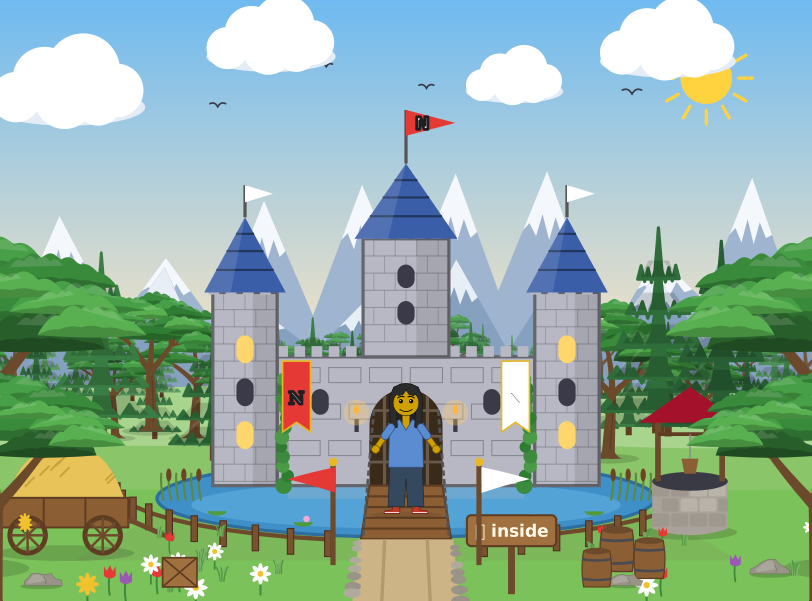
- In two months, what the game draws; not the game. About 56% of the code is pure: settings in, a picture out (the friend, the poses, the places). That ports piece by piece, and each piece can be checked exactly: the picture archive holds the game's own SVG for every place, costume and pose, with the settings that made it, so a Hazel piece is done when the same settings give the same SVG.
- In three months, also the rules: what is in the way, planned walks, the tunes as data, the world designer and the first settings as livelit GUIs. The frame loop, the controllers and the sound would still be JS.
- The runtime waits on Hazel, not on time. A frame at 60 a second has 16 ms; a livelit release is 0.13 to 0.5 s today (from 4.6 s at the start of the month). Hazel lacks a clock, a sound binding and a way to measure a drawn picture. So the plan keeps JS as the engine and makes Hazel the source of the pictures, as a livelit's view is.
- Measure before believing either schedule: port the face alone (431 lines) and time it, in week 1.
- Decide first what "ported" means: the same picture from the same settings (checkable now), or the whole game running in Hazel (not reachable in three months).
What the game is made of
Figure 1. The game's code by part, in lines (wc -l of js/, version 0.0.289), coloured by kind: pure (settings to picture), runtime (frames, input, sound, measuring the drawn picture), tool (the settings' controls and the archives).
| part | lines | what it is | what it rests on | kind |
|---|---|---|---|---|
| The friend 03 face, 04 hair, 05 ghost, 06 costumes, 07 underwear, 08 body | 2,350 | the face, hair, body, clothes, shoes, costumes, see-through layers: a picture from the settings | SVG text built by string functions; settings in one state object | pure |
| Poses and moves 17 moving and climbing (moveNow, the rig), part of 18 drawing | 1,700 | the pose rig, each animation's pose at a phase (walk, crawl, swim, climb, sit, lie, balance) | a phase from the music's clock (LFO B), the rig's joint maths | pure |
| The places 09 backgrounds, 10 nature, 11 houses and huts, 12 clearing and castle, 13 castle rooms and map, 14 outdoors, 15 place picker | 8,650 | about 40 places, castle rooms and tree rooms, each drawn from its settings; each thing standing there an object with a depth | SVG text; obj(name, depth, svg) for the depth sort; part() caches keyed on the settings read | pure |
| Drawing a frame 18 drawing | 1,070 | the friend among the place's objects, by depth; the scene cache; still pictures on slow computers | the DOM (mounting, measuring), requestAnimationFrame | runtime |
| Things in the way and walking 16 objects and solids, 26 drags and start (walks) | 2,400 | collision boxes and ovals, the back line, planned walks round them, the controller's steps | boxes MEASURED from the drawn picture (getBBox, getScreenCTM: 50 calls), then pure geometry | runtime |
| The music 19 music | 1,850 | 60 tunes as data (chords, parts, forms), the mixing board, LFOs the scenes follow | WebAudio for the sound; the tunes and the board are pure data | runtime |
| The world and its settings UI 20 controls, 25 world, 21 to 24 | 3,600 | every setting's control (1,337 rows in Background alone), the world designer, saves | the DOM, localStorage, files | tool |
| Input 26 drags and start (the rest), 22 full screen | 1,100 | pointer drags of joints and things, a game controller and the on-screen one, keys | DOM events, the Gamepad API, 60 polls a second | runtime |
| The checks and archives tools/ (130 checks), dress-up-pictures, dress-up-music | 0 | the picture archive (every place, the friend in it, as SVG plus its settings), the music archive, the speed gate | headless browsers driving the game | tool |
What Hazel has, and lacks
- User-defined livelits: init, view and update, with splices (splice_new, splice_set, splice_eval): a livelit's model and its GUI, in the editor (integration branches, hazelgrove/hazel#2597 and #2635; not on dev)
- The Livelit Playground: slides already port pieces of the friend from this game: Polygons, Shirt and Pants, Shoes and Hair, Kids' Choice, the 1990s Face; each a picture built as SVG text from a model
- Pictures as values: SVG is text Hazel can build: floats with +. and friends, to_fixed for numbers, strings, lists of shapes drawn in order
- Types: records, labelled tuples, sums, System F over values (typfun, explicit @<T>); Modules II for libraries. No type application (no M(a) for a type constructor M)
- Speed: a livelit release about 0.13 to 0.5 s on the faster branch (#2635) after this month's work (from 4.6 s), against under a millisecond for this game to draw the friend and 16 ms for a frame at 60 fps
| lacks | why the game needs it | what to do |
|---|---|---|
| A clock | walking, swimming, swaying scenery: a pose at a phase every frame | keep SMIL animations in the drawn SVG (they are text, and play without Hazel: the places' code writes animations in about 150 places today); per-frame motion stays in JS until a view can be fed time cheaply |
| Per-frame speed | 60 frames a second leaves 16 ms; a Hazel evaluation of a view is 100 times that today | Hazel computes what a frame shows only when settings change; the JS loop moves the friend and plays the SMIL in between |
| Measuring a drawn picture | collision boxes are measured from the DOM (getBBox) after drawing | compute each object's box from its geometry in the same function that draws it: a better design anyway, and testable |
| Sound | WebAudio has no Hazel binding | the tunes as Hazel data (they already are data), played by the JS synthesizer |
| Imports between slides | a library module is copied into each slide | one program per piece, or a library mechanism first |
| A big program in the editor | 22,000 lines of JS is perhaps 15,000 of Hazel | measure the editor's statics on a program that size early (the statics scaling probe of 10-09 found about 1.4 times the work on the slides, not re-analysis) |
Two months
| what moves | the oracle | still JS at the end | |
|---|---|---|---|
| week 1 | The settings as Hazel types: body, face, hair, clothes, background, as records with their defaults; a save's JSON read into them | every saved settings file in the picture archive parses and prints back the same | |
| week 2-3 | The friend's drawing: face, hair, body, clothes, shoes, as functions from settings to SVG text, ported part by part (03 to 08) | the archive's body, face, hair, shirt, pants, feet and costume pictures: same settings, same SVG, byte for byte | |
| week 4 | The pose rig and every animation's pose at a given phase (moveNow): pure maths | the archive's moves pictures, and poseJoints at sampled phases | |
| week 5-7 | The places, ten a week, the simplest first (the empty room, bubble space, the tent) to the castle's rooms; each thing an object with its depth | the archive's backgrounds pictures, place by place | |
| week 8 | The friend among a place's objects by depth: one picture of a frame, held still | backgrounds-with-friend, held at time 0 | the frame loop, input, collisions, walking, music, the controls, the world designer, saves |
Three months
| what moves | the oracle | still JS at the end | |
|---|---|---|---|
| week 1-8 | As the two-month plan, at a gentler pace where the castle rooms need it | as above | |
| week 9 | Collision boxes computed from geometry, in the drawing functions, then the planner (planPath is pure already) | the archive's collision-box pictures; the planned-walk sweeps of tickets 332 and 358 | |
| week 10 | The tunes and the mixing board as Hazel data; the scenes' LFO followers | the music archive's settings; the JS synthesizer plays the Hazel tunes and the MP3s match | |
| week 11 | The world designer as a livelit: the grid of places, their ways, each square's settings | a world saved in the game opens in the livelit and back | |
| week 12 | The settings' controls as livelit GUIs, Background first, the knolling of ^du_report(5) as their design | a few hundred settings round-trip | the frame loop, input, WebAudio, the archives' tools |
Risks
| risk | why | what to do |
|---|---|---|
| Speed | the friend's picture alone is a large view; if a release stays near half a second, a slider drag in Hazel feels slow next to the game's | measure the friend's drawing in Hazel in week 2, before porting further; ^report(1)'s series has the method |
| Size | the places are 8,650 lines; ported straight they may strain the editor | a place per program, joined only by the settings types |
| Drift | the game keeps growing nightly (289 versions in a week); a port chases a moving target | freeze a version to port (0.0.289) and log what changes after it, or port only pieces the children have settled |
| The 60 fps rule | nothing that runs per frame should go through Hazel's evaluator yet | Hazel decides what is drawn; JS moves it |
What to decide first
- What "ported" means: draws the same picture from the same settings (the oracle can check it), or runs the whole game in Hazel (needs a clock, input and sound Hazel lacks).
- Where the Hazel code lives: Playground slides, one piece each, or a library module and one program; slides cannot import each other yet.
- Which version to port: a frozen one, with the changes after it logged, or the moving game.
- Who plays the Hazel version: the children, in the editor, or only the archive's oracle until the pieces join.
What next
- 1. Decide what ported means: the oracle (same settings, same SVG) or the whole game; this report assumes the oracle for two months.
- 2. Measure first: port the face alone (03 face, 431 lines) and time a release of its view in Hazel, before any schedule is believed.
- 3. Compute boxes from geometry: move collision boxes from DOM measuring into the drawing functions in the JS game first (it helps the game, and makes the port pure).
- 4. Freeze a version: tag the version to port (dress-up-0.0.289) and keep a log of what changes after it.
- 5. One program per place: try the empty room, bubble space and the tent as three small programs sharing the settings types.
- 6. Keep the JS as the engine: the frame loop, input and sound stay JS; Hazel supplies the pictures, as a livelit's view does.
How this was put together
Written on 2026-10-18 by Claude, for Matthew, from the game's code (line counts, and where it measures the DOM or runs per frame), its VERSIONS.md and checks, the picture archive's folders, and what earlier work recorded about Hazel's livelits and their speed (the Hazel performance analysis series [3]; the livelits paper [1]). Nothing new was measured; the schedules are estimates, and an earlier note found estimates here running about five times high, so week 1's measurement matters. The data is in data/report.json and in this page; the page is built by drivers/build.py.
- Cyrus Omar, David Moon, Andrew Blinn, Ian Voysey, Nick Collins, Ravi Chugh. Filling Typed Holes with Live GUIs. PLDI 2021.
- Cyrus Omar, Ian Voysey, Michael Hilton, Jonathan Aldrich, Matthew A. Hammer. Hazelnut: A Bidirectionally Typed Structure Editor Calculus. POPL 2017.
- Hazel performance analysis series (matthewhammer.org/hazel/performance-analysis/)